
Pump-Off Controllers (POC): How Much Can They Really Save?
Author: Amplified Industries•Published: January 25, 2026

Pump-off controllers (POCs) are local automation devices designed to fine-tune the runtime of a rod pump, maximizing production while avoiding overpumping. A typical setup includes a load cell (strain gauge transducer) mounted on the polished rod, an inclinometer, and a control enclosure with a Programmable Logic Controller (PLC).
Despite being a mature form of artificial lift automation with widely acknowledged economic benefits, adoption remains low. Fewer than 20% of U.S. rod pump wells currently use a pump off controller. And even fewer operators take the time to run proper production optimization and cost analytics before making the investment. So, we ran the numbers.
From Field Results to Production Optimization Forecasts
At Amplified Industries, our analysis draws from a dataset of over 1,000 rod pump assets across multiple regions. From that data, we’ve developed a reliable rule-of-thumb when transitioning from manual or timer-based control to POC-driven oilfield automation:
- 5–10% increase in production
- ~50% runtime reduction, translating to a ~30% decrease in electricity costs
- Significantly reduced wear and tear, with a 50–100% increase in mean time between failures (MTBF)
- 30–50% decrease in total maintenance costs
All-in, a basic pump off controller (POC) setup typically costs around $12,000, not including SCADA integration or telecom services. With an oil price of $75/Bbl, MTBF of 12 months, and a $10,000 pulling cost, the payback potential is clear:
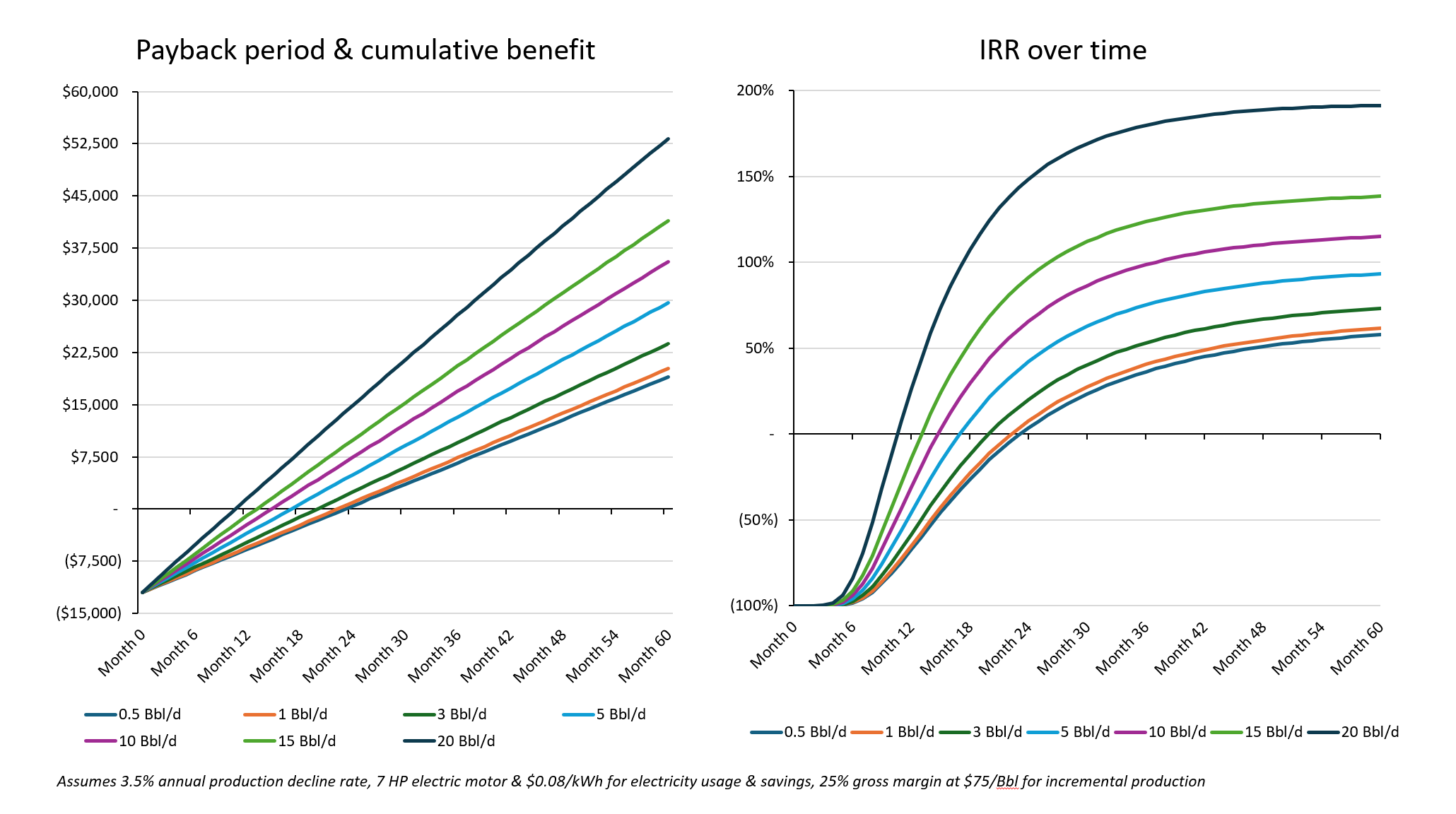
✅ At 5+ BOPD, payback is < 1 year and IRR exceeds 100% over two years.
Where the Real Payback Comes From
For wells producing over 5 barrels of oil per day, the investment in a pump-off controller becomes compelling. Reduced energy consumption, fewer well interventions, and extended equipment life all contribute to a payback period of less than a year.
Beyond cost savings, operators see improved uptime and more effective artificial lift optimization. When modeled across varying production levels, the internal rate of return (IRR) often exceeds 100% within a two-year period.
We’ve summarized these projections in the chart below:

Why Traditional Pump-Off Controllers Don’t Work for Everyone
Despite their advantages, traditional pump off controllers present real challenges particularly for stripper wells and lower producing assets.
For wells producing under 5 BOPD, the upfront cost often stretches payback periods beyond what’s practical. These systems also require ongoing maintenance, frequent recalibration, and hands-on technical support to stay effective.
In addition, most legacy POCs operate as standalone systems, relying on separate SCADA and telemetry infrastructure. This limits integration with other field equipment and reduces overall visibility. For many teams, POCs become technical “black boxes,” making it difficult to extract ongoing value.
While industries around them have advanced with AI, machine learning, and edge computing, the core design of many commercial POCs has remained largely unchanged for decades, leaving them misaligned with the needs of today’s lean, efficiency-focused operators.
A Smarter, Scalable Approach to Pump-Off Control
There’s no debate that pump-off controllers improve production optimization. The challenge lies in scalability. Traditional approaches often introduce too much cost, complexity, and operational friction— especially for independent operators without dedicated automation teams.
That’s where Amplified Industries takes a different path.
By combining intelligent oilfield automation, machine learning, and edge-based intelligence into a turnkey platform, we deliver the benefits of pump-off control and artificial lift optimization without the burden of legacy SCADA systems or specialized engineering staff.
Operators gain:
- High-fidelity operational data
- Smarter artificial lift control
- Faster, more confident decision-making
- Lower total cost of ownership
It’s modern automation, built to scale with real-world operations.
Turning Insight Into Action
Understanding the economics of pump-off control is the first step. Applying it in a way that fits your wells, your team, and your operating model is where the real value is created.
If you’re evaluating pump-off controllers, questioning whether traditional systems make sense, or looking for a more scalable path to production optimization, our team can help you assess the opportunity and run the numbers—without pressure or assumptions.
Let’s talk through what smarter pump-off control could look like for your field.
Reach out to Amplified Industries to start the conversation.